
Insects & Flies of the Highlands
By: Ed Herbst
Insects
The streams and rivers in the Highlands are extremely nutrient-rich, so not only are there numerous food forms upon which fish prey, but they occur in abundance. This accounts for the many trophy trout and yellowfish the region produces. An important point though, is that you don’t need to imitate a multitude of different insect species to fish successfully. Knowledge of the basics in aquatic entomology is, however, useful.
Mayfly (Baetidae)
All the main mayfly types, the clingers, crawlers, swimmers and burrowers, are found in abundance in the streams. There are fewer mayfly species in still waters, but they do occur prolifically at times – such as during a Caenis hatch – when they can cause avid, selective feeding. The most prolific mayfly species in streams and rivers are the Baetis family, especially Baetis harrisoni and Demoreptus natatensis while the tiny Tricorythidae discolor, aptly known as the “Angler’s Curse”, hatches in clouds over dams and the slower, silt-bottomed sections of these rivers.
Caddis (Tricoptera spp)
Caddis flies are an important food source for trout and yellowish, both in the larval and pupal stages as well as adult flies. In the Highlands, the most commonly found caddis is Cheumatopsyche afia which, incidentally, is highly variable in colour. Remember that adults tend to
skitter across the water once hatched so, under such circumstances, a twitched fly often works well.
Leaf-eating Beetles (Chrysomilidae)
It is rare that a trout’s stomach does not contain a beetle and they are known to take beetle patterns opportunistically even when selectively feeding during a heavy mayfly or caddis hatch. By far the most common beetle in the Highlands is the bronze-green, leaf-eating Chrysomilidae beetle that is found in great numbers in October and November, but also in late summer and autumn. The black, mite-like larvae feed on willow leaves for two to four weeks and then pupate, emerging as mature green beetles about half a centimetre long.
Sawfly (Nematus oligospilus)
Sawflies first appear in late October and are found until autumn. A relatively recent newcomer from America, the sawfly was accidentally
introduced into Lesotho in a plant consignment and was first recorded in Maseru in 1993. They subsequently spread to South Africa. Here, their host-specific food source, the imported willows, Salix babylonica and S. fragilis, had been imported to Parys in 1906 in the hopes of starting a basket weaving industry. In the absence of any indigenous biological control organisms these trees rapidly colonised high altitude streams providing the newly-arrived sawfly – a primitive form of wasp – with an almost unlimited food supply. The larvae of the sawfly, a green caterpillar, incorrectly given the generic name “inchworms” by anglers, has introduced a significant new food source for trout and yellowfish resulting in bigger fish in better condition. An examination of fish stomach contents, particularly those caught between heavily wooded banks, show that fish feed almost solely on this insect at times.
Diptera
In the late afternoon, midges hovering over the water can play a significant role in the “evening rise” on streams and, on dams, emerging midge pupae can provide frenetic activity as the sun sets. They are by far the most important food source for trout in dams but they are of relatively minor importance to the river fly fisher, other than in high altitude streams where hatches of the Net-winged midges, Blepharoceridae, are prolific at times.
Odonata
Dragon and damselfly nymphs are present in rivers and dams throughout the season and form a significant part of both trout and yellowfish diet, though they are more abundant and available in stillwaters than in streams.
Terrestrials
The presence of grasshoppers, beetles and ants, like any other insect, is cyclical but, whenever they occur, they are attractive to trout and worth imitating. Most fly fishers in the Highlands tend to use a nymph, fished dead-drift behind a yarn strike indicator as an imitation of the dominant food source for fish in the region – mayfly nymphs – while striving at all times to get a drag-free drift. Fishing a hopper can offer a welcome relief from the rigours of concentrating on drag-free drifts – you can slap it down on the water surface and, when it starts to drag, you can twitch it like a small popper because that is how hoppers behave when they land in the water. They drift for a while and then kick frantically towards the bank.
Flies
Most reputable fly-shops will offer a variety of patterns but you need to be discerning in choosing an effective selection for this region.
The dry fly produces best on the clear, small streams at higher altitudes whereas, in the pastoral, slower-flowing sections of rivers where agriculture is practised, like the deeper, more turbid stretches of rivers like the Sterkspruit and the Kraai in Barkly East and Rhodes and the Pot and Wildebeesspruit in Maclear, are better suited to the nymph.
For evening mayfly hatches you would be hard-pressed to beat that perennial, worldwide favourite, the Adams dry fly in any of its guises, but particularly the Parachute Adams. Sizes 12 through 16 will suffice. For caddis larvae, the green rock worm patterns, so beloved of those who fish the Vaal for yellowish, will suffice and for adults, one can’t go wrong with the Elk Hair Caddis or the Kaumann’s Stimulator. For midges, those who tie their own flies are at an advantage because flies tied with Cul du Canard (CDC), soft, wispy feathers found round a duck’s preen gland, have unrivalled properties, landing softly and floating well. Many suitable patterns such as the Arpo, the IOBO (It ought to be outlawed) and a range of patterns by Agostino Roncallo can be found on the internet. Few, however, are more suitable than Darryl’s Midge, a pattern developed by Darryl Lampert of Cape Town and featured on the Flytalk and Global Flyfisher websites. If you don’t tie your own flies then a #18 – 20 Griffiths Gnat fished on a 6 or 7x tippet is your best bet.
Attractor dry flies, such as the Klinkhamer, Royal Wulff, Kaufmann’s Stimulator, the Caribou Spider, the RAB and a Red Humpy will serve you well in non-hatch periods. The better fly shops will have imitations of the tiny Trico mayfly and it’s worth having a few patterns in your box just in case you encounter a hatch.
On rivers and dams the DDD is hard to beat as an impressionistic imitation of a wind-blown terrestrial. It makes an excellent prospecting pattern and, on dams, is best fished on sunny days along wind lanes when nothing is hatching and fish aren’t rising. For caddis dries, the Elk Hair Caddis, the Goddard Caddis or the Stimulator are all you need and they are valuable patterns for prospecting likely lies when the fish are not rising. On dams a San Juan worm, as a bloodworm imitation, can be deadly fished below a DDD and allowed to drift with the wind.
Don’t forget the importance of the terrestrial insects on rivers and dams. Grasshopper, beetle, ant and inchworm patterns can be as effective fished under the surface as they are on top.
Peacock-herl flies like those perennial favourites, the Coch-y-Bonddhu in size 16, tied on a light-wire hook as a floater or the soft hackle, Black and Peacock Spider fished as a sinker are all you need to imitate the Chrysomilidae beetles. A tungsten-bead version, fished like a nymph with a strike indicator can be deadly, particularly in faster, deeper water.
On windy days at the peak of the inchworm cycle, the caterpillars can carpet the water and, particularly with yellowfish which is a shoaling fish, provide frenzied rises. The inchworms tend to float for quite a distance and this provokes selective rises to the floating insect from fish holding in the current tongue below the trees harbouring the little green worms. Under such conditions, sinking inchworm patterns are likely to be ignored. In the absence of wind and when fish are not rising, a tandem rig of a chenille inchworm fished suspended below a green foam imitation is always deadly on wooded beats when these caterpillars are feeding on the leaf canopy. The Working for Water programme has seen the number of crack willow trees along Highland streams considerably reduced and this, in turn, has reduced the number of inchworms available. Nevertheless, they will always be present and my guess is that inchworms are, by now, well fixed in the neuronal memory loop of trout.
Hopper patterns can provide exciting fishing, particularly in hot, windy conditions and you will rue the day that a mating flight of ants carpets the water with tiny bodies, the fish are going dilly and you don’t have a few ant imitations handy.
For mayfly nymph imitations one can’t go wrong with the original and subsequent bead-head and flash-back versions of those time-honoured killers, the Gold Ribbed Hare’s Ear and Frank Sawyer’s Pheasant Tail nymph. Tom Sutcliffe’s ZAK nymph, which combines the best of both these flies, has become a favourite fly with many who fish the nymph in this region.
In stillwaters I would not be without a few midge patterns. I have mentioned the larva, the bloodworm and these are effective in red or green. An examination of stomach contents from trout caught in local dams will often reveal a high number of glassy green midge larvae as well as the more common bright red specimens. Countless midge larva patterns exist and it’s anyone’s guess which is best. But just as important as the larva, are the emerging midges, sometimes called buzzer patterns. Make sure you have red and tan patterns in sizes 14 and 16 in your stillwater fly box. Fish them, on a greased leader, just a few centimetres
under the water surface to those classic, porpoising lake trout that tend to sip a steady beat, often very near the shallows. At times, these fish will be sipping adult midges and the Griffiths Gnat is an unbeatable imitation.
Stomach content studies done by Bob Crass in Natal and Dr Vern von Someren in the small streams of Kenya show that mayfly nymphs, particularly Baetis, are, by a significant margin, the staple food source for rainbow and brown trout in Africa. They average little more than a centimetre in length and with tungsten beads now available down to 1.5 mm, the tying of weighted #16 and 18 soft hackle or flashback Pheasant Tail and Hare’s Ear nymphs in an equivalent length becomes practical.
There will be few occasions during your visit to this region when the fish will feed selectively and ignore everything but one species of insect. In spring and early summer on the more wooded beats, inchworm and beetle patterns are a must, particularly if splashy rises are seen every time a breeze shakes the leaf canopy. In the late afternoon, emerging mayflies and recently-fertilised mayfly females returning to the water to lay their eggs will require a small, black, parachute pattern or the Adams equivalent. But, for the rest, good stalking skills and delicate presentation count for as much, if not more, than pattern selection.
Tactics
Fishing small, rocky, high altitude streams where there are few or no trees such as the Gateshead section of the upper Bokspruit, requires very different tactics to fishing, say, the bigger, slower, tree-lined Birkhall section of the Sterkspruit which is at a lower altitude and has a predominantly gravel river bed. The former have very few stream-borne leaves and twigs and trout can thus be reasonably sure that something floating on the surface could be food and thus worth rising to. The pastoral, lowland rivers, in contrast, have a much higher ratio of plant material and thus trout are far more inclined to ignore dead-drift flies at any level.
On these bigger, slower rivers with fewer rocks, the trout tend to hug the undercut banks and you need to target the banks and animate the fly with lifts or by moving the rod tip. Furthermore, any logjam will harbour a fish and you must get the fly very close, or better still, beneath the deadfall to provoke a take.
Patterns for these larger rivers benefit from being bigger and from incorporating materials which provide movement e.g. rubber legs, palmered hackle and marabou tails. A bead head Woolly Bugger, for instance, which could imitate a high-calorie food source like a crab, may well be more effective than a streamlined, relatively inanimate pattern like Frank Sawyer’s original PT nymph. On the small streams of the Western Cape we have seen a resurgence of soft hackle patterns for the very reason that they have innate movement even when being fished dead drift. And although the traditional version of the Soft Hackle is tied without
tails, I have discovered that incorporating tails made from “bait cotton”, (a very thin, translucent lycra used by rock and surf anglers to secure soft baits to their hooks), significantly improves the attractiveness of these century-old flies. First colour the tails with a red or light brown permanent marker – I use Letraset Pro-markers – let them dry and then speckle them with a black marker.
Be alert to your surroundings. If you are fishing a grass-lined stream and storks are very much in evidence then the chances are good that a hopper pattern is going to work – they are not known in Afrikaans as “Sprinkaanvoëls” for nothing! Look for hoppers in the grass as you approach the water. If they are present in significant numbers you can improve your chances by using a hopper-dropper combination of a foam-bodied, rubber-leg hopper imitation and, suspended below it, a small PT nymph tied to the bend of the hook, New Zealand-style. A sinking, rubber-leg hopper, tied with a tungsten bead and water-absorbent materials such as a chenille body and a raffia wing and fished in front of a yarn strike indicator, can be even more effective than the floating version. This is because it is drifting at the level where the fish are holding and they accordingly do not need to move upwards through the water column to intercept the fly.
And, if you see sporadic rises beneath a bankside tree every time the breeze ruffles its leaves, you can tie on a beetle or inchworm pattern with confidence. Better still, when you get to the river, first examine the crack willows and check their leaves to ascertain whether inchworms are present in sufficient numbers to justify tying an imitation to your tippet and then check the weeping willows for the presence of Chrysomilidae beetles.
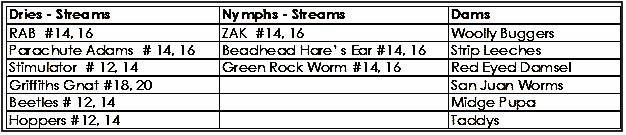
A list of flies for the Highlands
A survey of leading fly shops produced the following lists of recommended patterns for the Highlands.
Several outstanding books and DVDs have been marketed in the past few years on tactics and flies for small-stream and still-water fishing. The best source for these is Craig Thom’s online book store, www.netbooks.co.za
Published courtesy of the Wild Trout Association